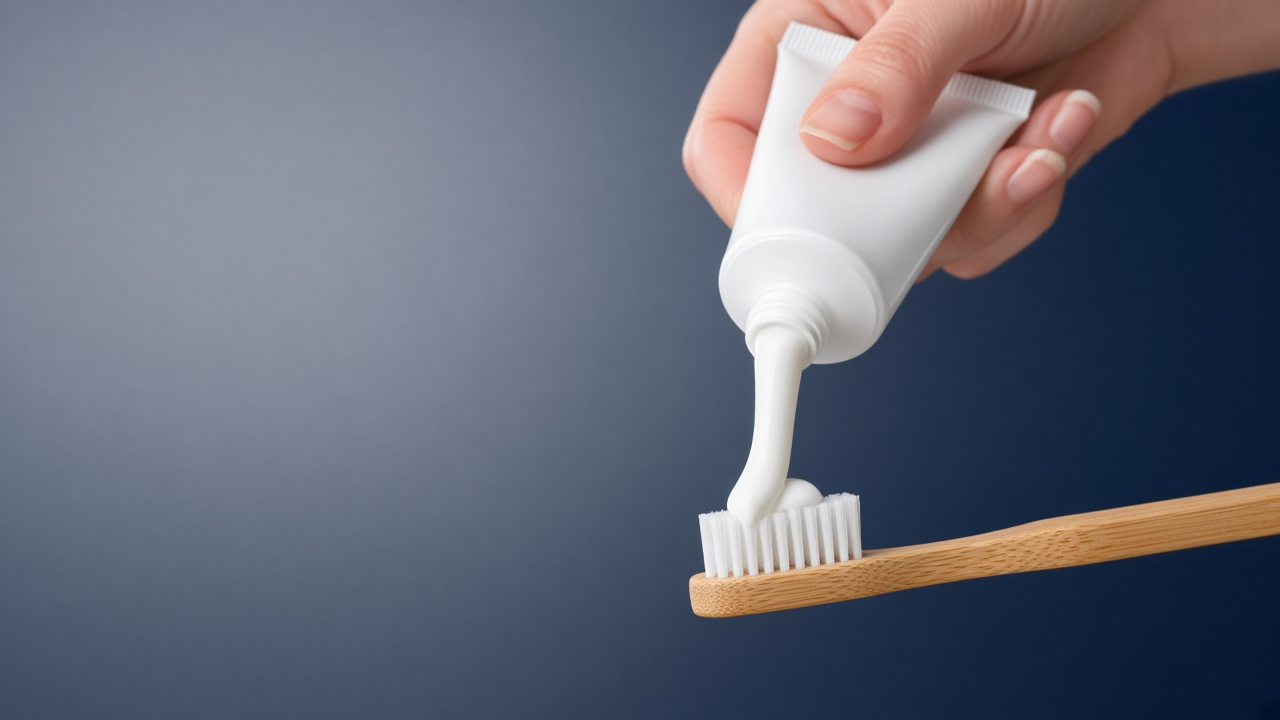
If you have typed “hydroxyapatite toothpaste” into a UK search bar, the job is usually modest: you have seen HAp or nHA on a Boots listing, a Healf product page, or an Amazon import, and you want to know what the mineral actually is before you swap out the fluoride paste the NHS still names. This page does that job in plain English. It is not a clinic, and it is not a ranking of tubes.
Hydroxyapatite toothpaste is a cosmetic oral-care paste that includes a manufactured calcium-phosphate powder. Brands shorten the mineral to HAp or HAP. They then split the powder into two families you will meet on pack: ordinary (often micro) hydroxyapatite, and nano-hydroxyapatite (nHA or n-Ha). Those labels describe particle size and regulatory paperwork. They are not a score for “stronger dentistry”.
What the mineral actually is
Hydroxyapatite is a form of calcium phosphate. It is the main mineral in tooth enamel and a large part of bone. Toothpaste makers add a synthetic version as a powder. After brushing, some people notice a temporary look of smoother enamel — a bit less chalky in the bathroom mirror. That is a cosmetic observation. It is not the same as filling a hole, closing a gap, or rebuilding a tooth.
You do not need a chemistry degree to read a tube. Look for the word hydroxyapatite, or for a trademark the company says contains it, and notice whether the copy says nano or micro. If the pack is silent on size, we leave it unspecified. We do not have a lab, and we do not invent a particle story to make a listing sound more precise. Enamel is a hard tissue built over years; a paste is a cosmetic you spit out. Marketing that slides from one to the other is the language we refuse to copy.
Nano-HAp and micro-HAp are not a league table
Nano-hydroxyapatite particles are small enough to be treated as a nanomaterial in cosmetic regulation. Japanese Apagard and several American pastes sold through UK specialist shops present themselves this way, as those brands state. Micro hydroxyapatite uses larger particles. Italian Biorepair describes its microRepair® powder as micro, not nano. The UK brand Truthpaste labels 5% micro hydroxyapatite on pack, as the brand states.
Particle size is a formulation choice, not a quality ranking. When we compare pastes we keep nano and micro in separate columns so a shopper can see the claim each brand actually makes.
In the EU — and, in practice, for many UK-sold cosmetics that still follow the same ingredient files — nano-hydroxyapatite is a cosmetic ingredient, not a medicine. The Scientific Committee on Consumer Safety has issued safety opinions on specified particles. Under the rod-shaped specifications discussed in the 2025 Submission IV opinion, nano-HAp in toothpaste has been considered at concentrations of up to 29.5%, provided the particles match those specs: broadly rod-shaped, not a needle-like high-aspect-ratio form, and not a coated or surface-modified powder we have not checked.
That is a safety envelope, easy to misuse. It does not mean every nHA tube contains 29.5% of anything, or that a Healf or Amazon listing has been checked against those specs by us. It is not an NHS recommendation, and it is not a licence to treat decay. If a brand’s percentage or particle shape is not published, we say so.
What this is not — and what the NHS still centres
UK public-health advice has not moved to hydroxyapatite. Delivering Better Oral Health still centres fluoride toothpaste at 1,350–1,500 ppm for adults and children aged 7+, used twice a day, with spit-don’t-rinse. Hydroxyapatite is not named there as a substitute.
People still choose fluoride-free pastes — taste, personal preference, a wish to avoid fluoride, or curiosity about a Japanese or Italian tube. Preference is allowed. Treating preference as if it were better-than-fluoride dentistry is not. This site is not an anti-fluoride campaign.
We do not claim that hydroxyapatite toothpaste cures, prevents or reverses cavities. We do not say it rebuilds teeth or fills gaps. If you have pain, swelling, a visible hole, or bleeding that does not settle, see a dentist. A tube from an online basket is not a treatment plan.
You will still meet posts that say nano-hydroxyapatite is “banned in Europe”. We do not repeat that as fact. Needle-shaped particles and incomplete dossiers have led to cautious wording; some products were reformulated. That is regulation of a cosmetic powder, not a ban on the mineral.
Retail wellness copy sometimes goes further than we will. Safer phrasing, used throughout Mineral Mouth, is “brand states…” for percentages and particle size, and a temporary look of smoother enamel for what some people notice after brushing.
A short map of where UK shoppers actually buy a tube
Hydroxyapatite toothpaste is still a specialist buy in Britain. You will not find a full nHA wall in every chemist. The high street has carried Biorepair and Gem at times; specialist shops have listed American nHA pastes; Japanese Apagard often arrives through Amazon UK; Truthpaste sells micro hydroxyapatite direct. Shelves change. Confirm the listing before you travel or click.
If you want a single Amazon UK starting point — not a product we have tested — there is a hydroxyapatite toothpaste search on Amazon UK. As an Amazon Associate I earn from qualifying purchases.
For the actual map of Boots, Healf, Amazon and direct-to-consumer paths, use the where to buy hydroxyapatite toothpaste in the UK hub. Do not treat this paragraph as stock advice.
What to read next
If you are weighing this mineral against the paste the NHS still names, start with hydroxyapatite vs fluoride toothpaste in the UK. If you already know you want a tube and need nano versus micro in a row, read the Biorepair vs Boka vs Apagard comparison. Newer explainers live in the guides index.
Mineral Mouth is faceless UK editorial. We do not examine patients, and we do not sell toothpaste.