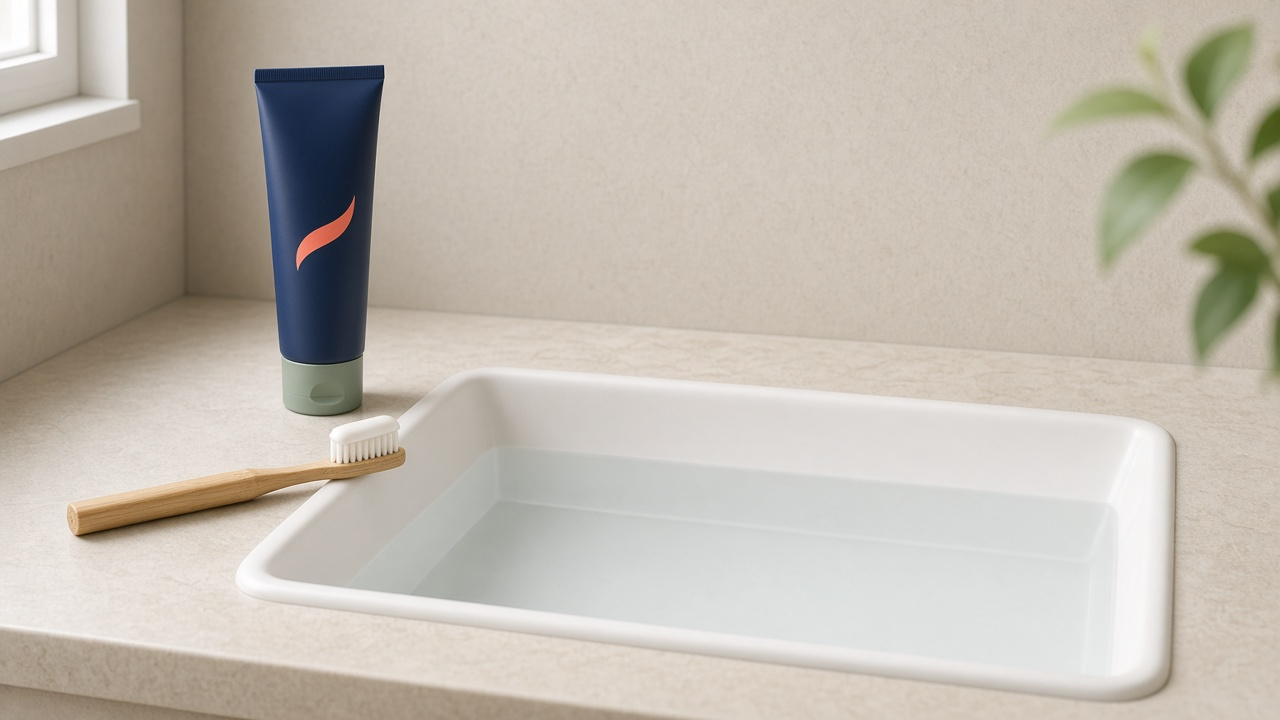
You’re brushing with a new hydroxyapatite toothpaste and the sink stays almost clear. The brush looks wet, not foamy. A usual mint from the chemist would have filled your mouth with bubbles by now.
That quiet brush is a common first surprise. It is not a sign the tube is empty. It is not a sign the paste has failed.
What does a normal UK toothpaste feel like on the brush?
A family fluoride toothpaste from a supermarket or a chemist usually foams. You put a pea on the brush, you brush for about two minutes, and the mouth fills with bubbles.
NHS teeth-cleaning advice still centres a fluoride toothpaste at 1,350–1,500 ppm for adults. Brush twice a day, including last thing at night. Spit, and don’t rinse straight away. It does not say the paste has to foam.
A hydroxyapatite toothpaste sits beside that picture. It does not replace the fluoride advice. A quieter brush does not make it a better paste. If a dentist has already chosen a fluoride toothpaste for you, stay with that plan unless they change it. How the two sit side by side is on hydroxyapatite vs fluoride toothpaste.
Why does the new tube stay so quiet?
Hydroxyapatite is a calcium mineral. Some toothpastes add it as a powder. After brushing, teeth can look a little smoother. That is a cosmetic change you might notice in the mirror. It is not a treatment for decay, and it does not rebuild a tooth.
The foam, or the lack of it, is a separate thing. It comes from detergents in the formula, not from the mineral. A brush with almost no bubbles can still be doing the ordinary job of brushing. A mouthful of foam is not proof that more cleaning happened.
After the first night, people often say the paste “doesn’t foam”, so it doesn’t feel like toothpaste. Read that as a comment on texture. It is not a result. It is not a reason to scrub harder.
What makes ordinary toothpaste foam?
Sodium lauryl sulfate, often shortened to SLS, is a foaming agent. It is the ingredient that turns a small smear of paste into a mouthful of bubbles. You will see it on many ordinary fluoride toothpastes. It is there for the feel.
Leaving it out is a product choice. It is not a medical upgrade, and it is not a reason to treat fluoride as a problem. Some people simply prefer a paste that does not foam as much. Others find a strong foaming agent harsh. That is a choice you can make for yourself.
Not every hydroxyapatite toothpaste leaves SLS out. A mineral on the front of the box does not tell you whether the paste will foam. You have to turn the carton over.
Which pastes stay quiet, and which still foam?
Two names come up when someone wants the quiet brush.
Truthpaste’s peppermint hydroxyapatite is a jar, not a tube. The ingredient list on that product page does not include sodium lauryl sulfate. Expect less of the supermarket foam. The taste includes peppermint and other oils, so quiet does not mean bland.
Apagard Soft is the other name. Sangi, the maker, describes Soft for people who react to foaming agents and strong flavours. It is not Apagard Premio, and it is not M-Plus. Those two ingredient lists include sodium lauryl sulfate, so they can still foam. If the box says Premio, you are not holding Soft. The names people mix up are on Apagard Premio vs Royal vs M-Plus.
Biorepair is the tube UK chemists have stocked. On the Total Protective Repair page, the brand says that toothpaste does not contain sodium lauryl sulfate. Another variant can read differently, so check the carton in your hand. The jar and that Italian tube are compared in Truthpaste vs Biorepair.
A low-foam paste is still a toothpaste. Use a pea, not a stripe the length of the brush. More paste will not create the bubbles you are missing.
How do you brush when there is almost no foam?
Keep the routine you already know. Morning, and last thing at night. A pea is enough. Brush the teeth you can reach, including along the gumline, for about two minutes. Spit. Don’t rinse the paste straight off with a glass of water.
Two minutes can feel longer when nothing is foaming. That is normal. Do not press harder to make up for the quiet. The brush does the cleaning. The bubbles do not.
If the paste feels gritty, stings, or tastes wrong, stop. Try another flavour, or another brand. Brushing longer will not fix a paste you cannot stand. The first few days mostly tell you whether you like it. What a few weeks can change in the mirror, and what they cannot, is on how long hydroxyapatite toothpaste takes.
When should you see a dentist?
A quiet brush is not a dental problem. Foam is not a sign of health. A lack of foam is not a sign of decay.
See a dentist for pain, a hole you can see, swelling, gums that keep bleeding, or sensitivity that does not settle. Do not wait to see whether a different texture sorts any of those out.
This is general information, not personal dental advice.
Where to buy in the UK
For Boots, Amazon UK, Healf, and Truthpaste, start with where to buy hydroxyapatite toothpaste in the UK. Read the ingredient list before you assume a tube is the quiet one. Premio is not Soft.
The jar that does not list sodium lauryl sulfate is on the brand’s own site: Truthpaste hydroxyapatite, 100 ml.
Biorepair is the high-street name. There is a Biorepair listing on Amazon UK as a backup to a Boots search for Biorepair. Check the variant on the day. A listing is a place to buy a tube. It is not proof that every Biorepair box leaves out the foaming agent. As an Amazon Associate I earn from qualifying purchases.
We do not have a checked product code for Apagard Soft, so there is no link for that tube.
What to read next
The wider map of names is on Biorepair vs Boka vs Apagard. How fluoride and hydroxyapatite sit side by side is on hydroxyapatite vs fluoride toothpaste. More explainers are on the guides index. How affiliate links work is on our disclosure.
Mineral Mouth does not examine patients or sell toothpaste.