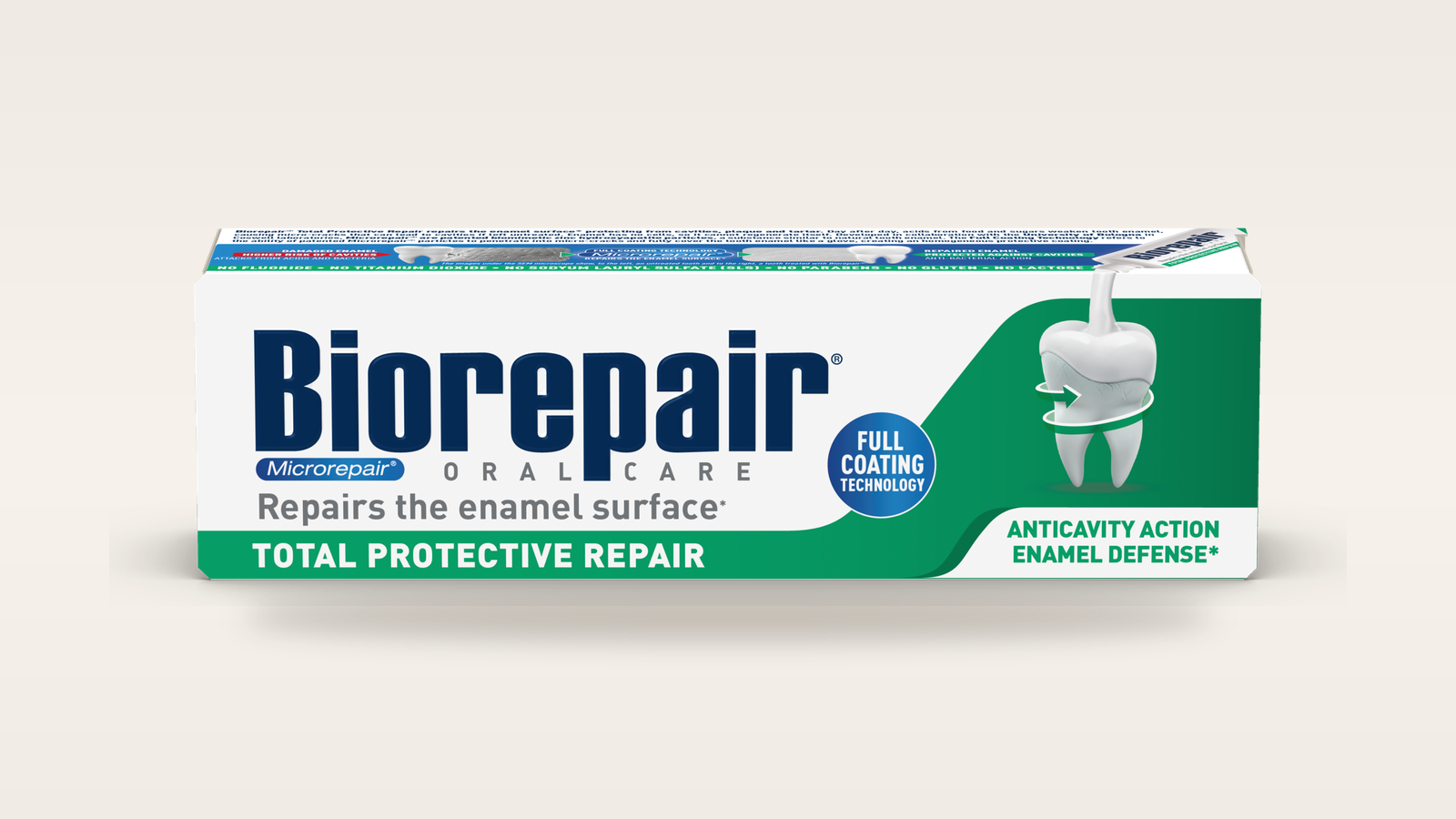
You’re in Boots, or on a Boots page, and the Biorepair carton has a word that is not the flavour. It says microRepair. You want to know if that is the mineral, a strength, or a different toothpaste.
It is the maker’s name for the powder in the paste. It is not a score.
What does the NHS still say about toothpaste?
The ordinary UK routine has not changed. Brush twice a day, including last thing at night, with a fluoride toothpaste. Spit, and don’t rinse straight away.
NHS teeth-cleaning advice says adults should use a paste with at least 1,350 ppm fluoride. On a family tube that is usually printed as 1,350–1,500 ppm.
Biorepair pastes are sold without fluoride. That is a product choice on this range. The tube can sit beside a fluoride toothpaste. It is not a swap for one a dentist has already set. How the mineral sits next to that advice is on hydroxyapatite vs fluoride toothpaste.
What does microRepair name on the carton?
microRepair is Coswell’s trademark for the hydroxyapatite powder in the Biorepair range. It is not a second brand sitting next to Biorepair on the shelf.
On the English carton for Total Protective Repair, the word sits under the Biorepair name, in a small blue badge. On Plus Total Protection, the carton prints a microRepair badge and a line for 200 mg/g of that powder. Same nickname. Different boxes. Which front says Plus, Night, or Total Protective Repair is the day and night guide.
Turn the carton before you treat the badge as the ingredient. The brand’s English page for Total Protective Repair lists Aqua, then Zinc Hydroxyapatite, with a star. The star says Microrepair. The front is the nickname. The ingredients line is the name to look for.
If the carton also says medical device, that line is a label on the box. It is not a result we have checked, and it is not a reason to skip a dentist.
Why does the list say zinc hydroxyapatite?
Coswell’s support page describes the crystals as hydroxyapatite with carbonate and zinc in the structure. The phrase there is substituted carbonate-apatite-zinc. A later note says the same thing more plainly: zinc-substituted carbonate hydroxyapatite.
That is why one line can say zinc hydroxyapatite while the front says microRepair. They are pointing at the same powder. Zinc, in that name, is part of the crystal the brand describes. It is not a vitamin on the side of the box, and we have not measured how much zinc is in a tube.
The support page goes on to talk about repair, plaque, and leaving fluoride out. We do not adopt that copy. After brushing, teeth can look a little smoother. That is a cosmetic change you might notice in the mirror. It does not rebuild a tooth, and it does not close a hole.
If the carton in your hand never mentions zinc, read the ingredients. Do not guess the powder from the logo alone.
Is microRepair a nano toothpaste?
The front says micro. It does not say nano-hydroxyapatite, nHA, or n-Ha. Those words show up on other pastes, including Apagard and Boka. Writing them onto a Biorepair box, because both kinds of paste mention hydroxyapatite, is a mix-up. The two size words are in the nano vs micro guide.
Coswell added a note on 5 June 2025 about particle size. It says the powder goes in as clusters about 5 to 10 microns wide, and that each cluster holds much smaller crystals, about 20 to 50 nanometres across. It also says the clusters stay intact when you brush. We have not measured a tube. A support note is not a new name for the carton. The pack in your hand still does not say nano-hydroxyapatite. Read the front, then the ingredients, and stop.
The trademark is not a percentage either. Two cartons can both say microRepair and still print different amounts.
What does the number next to microRepair mean?
Some boxes print a figure beside the badge, in milligrams per gram or as a percent. On Plus Total Protection, the carton and Coswell’s concentration note, updated on 29 April 2025, both give 200 mg/g. The note also writes that as 20%. The same note gives Plus Sensitive Teeth as 240 mg/g, or 24%.
We have not weighed the powder. Those figures are the brand’s amount of microRepair, the zinc-and-carbonate mixture it describes. The note does not publish a separate percentage for the zinc on its own. Do not turn 20% into a different number that is not printed. A higher figure is not a better toothpaste.
The note also says mass-market Biorepair toothpastes typically contain at least 15% microRepair. That is the brand’s own floor for the mixture. It is not a test we ran, and it is not a number you need to chase.
What a percentage on a hydroxyapatite carton does and does not tell you is in the label guide.
When should you see a dentist?
See a dentist for pain, a hole you can see, swelling, gums that keep bleeding, or sensitivity that does not settle. The word on the carton will not answer that.
This is general information, not personal dental advice.
Where to buy in the UK
Start with a Boots search for Biorepair and read the carton that is actually listed. Shelves change. microRepair can show up on more than one variant. The name on the front still tells you which box you have.
The Amazon tube we have already checked is Plus Total Protection: Biorepair Plus Total Protection on Amazon UK. Confirm the title says Total Protection, and check the seller, before you buy. That listing is one carton. It is not every Biorepair box. As an Amazon Associate I earn from qualifying purchases.
Boots, Amazon UK, Healf, and Truthpaste sit together on where to buy hydroxyapatite toothpaste in the UK.
What to read next
Which Biorepair carton is the everyday tube, and which one says Night, is on Biorepair day and night. The wider row of names is on Biorepair vs Boka vs Apagard. More explainers are on the guides index. How the shopping links work is on our disclosure.