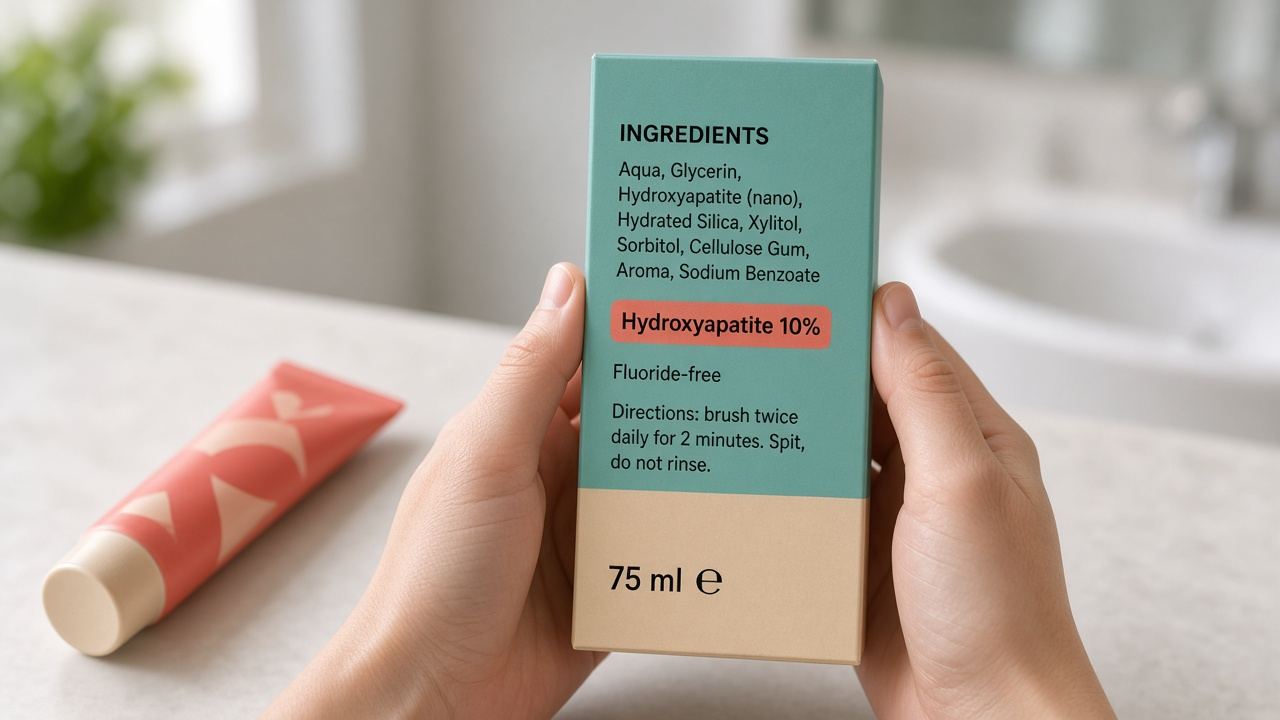
You’re in the shop with a hydroxyapatite toothpaste in your hand, trying to work out what the percentage means before it goes in the basket. One pack says 5%. A comment you read said 10%. Another tube only says nHA. Those are not three scores on the same test.
What does a normal UK toothpaste box already say?
The daily routine has not changed. Brush twice a day, including last thing at night. Spit, and don’t rinse straight away.
NHS teeth-cleaning advice says adults should use a fluoride toothpaste with at least 1,350 ppm. On a family carton that is usually 1,350–1,500 ppm. That figure is fluoride. It is not a hydroxyapatite strength, and a different mineral on the same shelf does not replace it.
A fluoride-free hydroxyapatite paste is a choice you can make for yourself. It is not an instruction to drop a paste a dentist has already set, and this site is not a campaign against fluoride. How the two sit side by side is on hydroxyapatite vs fluoride toothpaste.
Where does hydroxyapatite sit on the pack?
Hydroxyapatite is a calcium mineral. Some toothpastes add it as a powder. After brushing, teeth can look a little smoother. That is a cosmetic change you might notice in the mirror. It is not a treatment for decay, and it does not rebuild a tooth.
On the carton, look for the word hydroxyapatite, not only a nickname. Then see whether the pack says nano, nHA, or n-Ha, or whether it says micro. Those size words have their own page, the nano vs micro guide. A percentage, if there is one, comes after the size word. If there isn’t one, leave the gap. Do not fill it in from a comment.
What does 5% mean?
When a UK pack prints 5%, read it as the brand’s own figure for how much hydroxyapatite it says is in the paste.
Truthpaste’s peppermint jar is the clear British example. The brand’s page states 5% micro hydroxyapatite, and also writes 50,000 ppm. That is the same 5% in a longer form. It is not a fluoride strength. Do not set it next to 1,350–1,500 ppm and treat them as the same kind of number.
A printed 5% is not a mark out of 100. A tube with no percent has simply not told you. It is not a weaker paste because the number is missing. The jar, and the Italian tube that often skips a simple percent, are compared in Truthpaste vs Biorepair.
What does 10% mean?
Shoppers meet 10% in more than one place, and the places do not mean the same thing.
Some papers and secondary write-ups say “about 10% nHA” about Japanese Apagard. Treat that as a reported figure, not a test we ran. If the carton in your hand does not print 10%, do not write it on. Premio, Royal, and M-Plus are different tubes, so a number beside one name does not travel. The line-up is in Apagard Premio vs Royal vs M-Plus.
A second 10% is older European paperwork, not a recipe. In 2023 the Scientific Committee on Consumer Safety considered specified nano-hydroxyapatite in toothpaste at up to 10%. In 2025, Submission IV (SCCS/1677/25) moved that toothpaste ceiling to 29.5%, for rod-shaped, uncoated particles that match the opinion. The same 2025 opinion considers mouthwash at up to 10%. A ceiling is the top of a safety file. It is not the amount in your tube, and it is not a number to shop for. That older figure, and the rumour that nano pastes have been taken off sale, are on the Europe guide.
Ten is a bigger number than five, so 10% can look like the one to pick up. It is not a ranking. A brand’s percentage, a comment about an import, and a regulator’s ceiling do not belong on one list.
What does an nHA concentration mean?
nHA means nano-hydroxyapatite. When a brand prints a concentration beside those letters, that is the brand’s figure for the nano powder. It is not a certificate that the powder matches the 2025 file, and it is not 29.5% copied onto the tube.
Plenty of nano packs print no percent. Boka states n-Ha, and a percentage was not clearly published on the UK listing we last checked, so this page does not invent one. If a listing only says hydroxyapatite, leave the size and the percent blank.
29.5% does not mean your tube contains that much, and it does not put a nano paste ahead of a micro paste that prints 5%. We have not checked a listing against that file.
How do you read the carton before you pay?
With the carton still in your hand, use this order.
Fluoride first. If a ppm is printed, set it beside the NHS 1,350–1,500 ppm for adults. No fluoride is a product choice, not an instruction to drop a paste a dentist has already chosen. Then the mineral: the pack should say hydroxyapatite, and nano, nHA, n-Ha, or micro if the brand is willing. A nickname such as microRepair is a maker’s name for a micro powder, not a percent.
Then the percentage itself. Whose number is it, and is a long ppm the same percent written out, or fluoride? If the percent is missing, stop. Do not borrow 5%, 10%, or 29.5% from another pack. These notes are for adult labels. For a child, or in pregnancy, use the kids and pregnancy guide.
When should you see a dentist?
See a dentist for pain, a hole you can see, swelling, gums that keep bleeding, or sensitivity that does not settle. A percentage on a carton will not answer that.
This is general information, not personal dental advice.
Where to buy in the UK
For Boots, Amazon UK, Healf, and Truthpaste, start with where to buy hydroxyapatite toothpaste in the UK. Read the variant in the basket, not the first picture.
The pack that states 5% micro hydroxyapatite in plain figures is on the brand’s own site: Truthpaste hydroxyapatite, 100 ml. The names people compare in shops are on Biorepair vs Boka vs Apagard.
To open listings and read what each one actually prints, there is an Amazon UK search for hydroxyapatite toothpaste. As an Amazon Associate I earn from qualifying purchases.
What to read next
The mineral, in plain English, is in what hydroxyapatite toothpaste is. More explainers are on the guides index. How affiliate links work is on our disclosure.