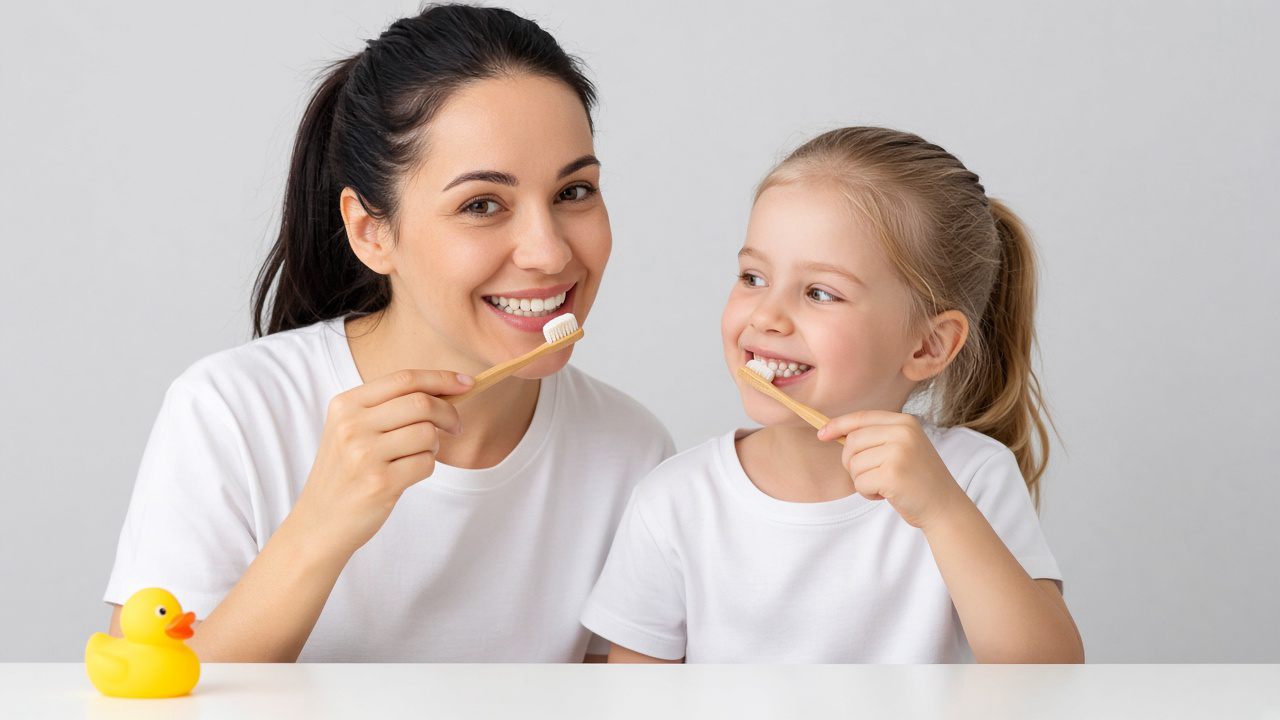
If you’re looking at hydroxyapatite toothpaste for a child, or wondering what’s sensible in pregnancy, start with the calm UK picture: what the NHS still centres for children’s toothpaste, and how to read an HAp carton without treating the marketing as medical advice.
Picture the bathroom first. A small brush, a small amount of paste, and a child who still needs a hand. Pregnancy is the same sink, with gums that may feel more tender than usual. The notes below follow that order.
What the NHS still says about children’s toothpaste
The daily job is ordinary. Brush the teeth. Use a fluoride toothpaste. Keep the amount small, because young children swallow some of what is on the brush.
NHS children’s teeth advice and the Best Start in Life tooth-care pages both start there. The number on the box is parts per million of fluoride, written as ppm.
Up to age 3, use a smear about the size of a grain of rice, with at least 1,000 ppm, from the first tooth. From 3 to 6, use a pea-sized amount of at least 1,000 ppm. In those years the children’s teeth page allows up to 1,500 ppm, so read the box. From 7, use the family strength: 1,350–1,500 ppm.
Brush twice a day, last thing at night and one other time. Spit, and don’t rinse. An adult should help until the child is at least 7. Children should not eat or lick toothpaste from the tube.
That is the picture a hydroxyapatite tube has to sit beside. It does not replace it.
Where hydroxyapatite fits for kids
Hydroxyapatite is a calcium mineral. Some toothpastes add it as a powder. After brushing, teeth can look a little smoother. That is a cosmetic change you might notice in the mirror. It is not a treatment for decay, and it does not rebuild a tooth.
Many children’s versions are made without fluoride. That is a product choice. It is not an NHS upgrade, and it is not automatically gentler for a toddler. An adult can prefer a fluoride-free paste after reading hydroxyapatite vs fluoride toothpaste. Taking a child off the fluoride toothpaste the NHS still centres is a separate decision.
If a dentist has already chosen a strength for your child, stay with it unless they change it.
Pregnancy and toothpaste — keep it simple
You do not need a new category of toothpaste because you are pregnant. You need to keep brushing, and to tell a dentist that you are pregnant.
Gums often bleed or feel puffy in these months, because they react more to plaque. Brush up to the gumline, morning and night. A different mineral in the paste is not the answer to that tenderness.
In England, NHS.uk says dental treatment is free while you are pregnant and for 12 months after the birth. Ask your midwife, GP, or health visitor for a maternity exemption certificate. Free means NHS treatment. Private work is still charged. Wales, Scotland, and Northern Ireland set their own rules.
A toothpaste is not how a baby’s teeth are formed, and it is not a calcium supplement. This page does not name hydroxyapatite as the pregnancy paste, and it does not tell you to avoid it. If you are unsure what to use, ask the midwife or dentist who can see you.
How to read a hydroxyapatite carton
Before a tube goes in the basket, turn it over.
The pack should say hydroxyapatite, not only a brand nickname. Then look for fluoride, and the ppm number from the section above. If the tube is fluoride-free and it is for a child, that is worth a conversation with a dentist.
Next, the size of the powder. Biorepair, which UK chemists have stocked, says its powder is micro, not nano. Apagard and Boka say nano-hydroxyapatite. Those are adult pastes. A nano label is not a reason to choose one for a child. If a percentage is not printed, do not guess it.
In 2025 a European consumer-safety committee looked at nano-hydroxyapatite in toothpaste. Where the particles matched the shape in that opinion, it considered amounts up to 29.5%. That is a note about a cosmetic formula. It is not advice for your child, and it is not advice for pregnancy. The words nano and micro are explained in the nano vs micro label guide.
Children still swallow toothpaste. A friendly picture on the tube does not change the smear or the pea.
When to speak to a dentist or midwife
Shopping can wait if something feels wrong.
See a dentist for pain, a hole you can see, swelling, or gums that keep bleeding. In England, NHS dental appointments are free for children. In pregnancy, book the check and mention the toothpaste you are using.
This is general information, not personal medical or pregnancy advice. If you need advice for your child or your pregnancy, speak to a dentist or midwife.
Where to buy in the UK
We have not checked a children’s or pregnancy version of these tubes, so there is no product code here to click. For Boots, Amazon UK, Healf, and Truthpaste, start with where to buy hydroxyapatite toothpaste in the UK. Check the shop page. An adult tube is not automatically one for a child.
To browse the category, there is an Amazon UK search for hydroxyapatite toothpaste. Treat it as a catalogue, not a shortlist for a child or for pregnancy. As an Amazon Associate I earn from qualifying purchases.
What to read next
The mineral, in plain English, is in what hydroxyapatite toothpaste is. Adult sensitivity sits on its own page, hydroxyapatite for sensitive teeth. The names shoppers meet are compared in Biorepair vs Boka vs Apagard. More explainers are on the guides index. How affiliate links work is on our disclosure.
Mineral Mouth does not examine patients, give pregnancy advice, or sell toothpaste.