You’re choosing one toothpaste that lists both fluoride and hydroxyapatite, and the front of the tube makes them sound like a single step up. Turn it over. The two lines in the ingredients are not the same kind of information.
What does a normal UK toothpaste already say about fluoride?
The daily routine has not changed. Brush twice a day, including last thing at night. Spit, and don’t rinse straight away.
NHS teeth-cleaning advice says adults should use a fluoride toothpaste with at least 1,350 ppm. On a family carton that is usually 1,350–1,500 ppm. That number is fluoride.
A second ingredient on the same tube does not replace that advice, and this site is not a campaign against fluoride. How a fluoride-free paste sits beside it is on hydroxyapatite vs fluoride toothpaste.
Where does hydroxyapatite usually sit on its own?
Hydroxyapatite is a calcium mineral. Some toothpastes add it as a powder. After brushing, teeth can look a little smoother. That is a cosmetic change you might notice in the mirror. It is not a treatment for decay, and it does not rebuild a tooth.
Plenty of the hydroxyapatite tubes UK shoppers already know are made without fluoride. Biorepair, Apagard, Boka and Truthpaste are in that group, as those brands present them. The word on the front does not tell you the fluoride status. You still turn the carton. A tube that lists both is a third kind of label, not a stronger paste.
What does a tube that lists both actually print?
Two examples you can check for yourself. Read them as labels, not as a shortlist.
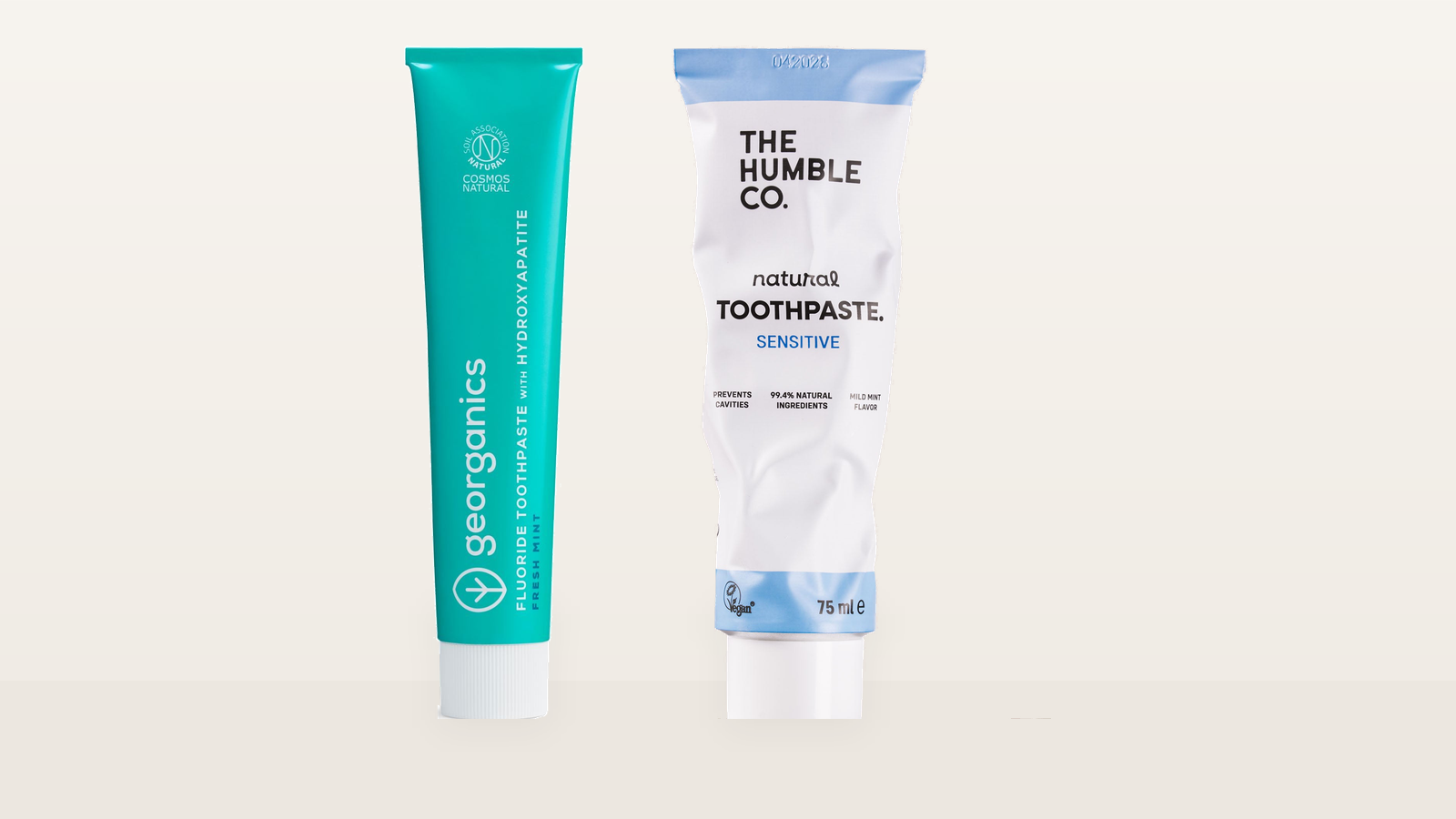
Georganics’ fresh mint fluoride toothpaste lists hydroxyapatite and sodium fluoride in the same ingredients. The brand prints 1,350 ppm beside the fluoride, and the tube is marked as a fluoride toothpaste with hydroxyapatite. That front line is a label, not a result. The brand’s fluoride range page describes the mineral as micro-hydroxyapatite. The ingredients line prints no hydroxyapatite percentage, so this page does not add one.
The same brand’s charcoal fluoride toothpaste also lists both, again at 1,350 ppm of sodium fluoride. Charcoal there is a separate ingredient, not another fluoride figure. Georganics also sells pastes without fluoride, and its range page describes a peppermint jar as fluoride and xylitol, without hydroxyapatite in that description. Match the tube in your hand to the ingredients.
The Humble Co’s Sensitive mint toothpaste also lists hydroxyapatite, and the brand states 1,450 ppm sodium fluoride. The same list includes potassium citrate. That is a sensitivity salt. It is not the fluoride line, and it is not the hydroxyapatite line. If sensitivity is why you picked the tube up, that question sits on hydroxyapatite for sensitive teeth. The brand’s fresh mint toothpaste, on the ingredients we checked, does not list hydroxyapatite at all.
1,350 ppm and 1,450 ppm both sit in the adult band the NHS describes. They are still fluoride figures. They are not a score for the mineral.
How do you read the two lines without mixing them up?
With the carton still in your hand, use this order.
Fluoride first. Look for sodium fluoride or sodium monofluorophosphate, and a ppm number. Set that number beside 1,350–1,500 ppm for an adult. If the ppm is missing, leave the gap. Do not borrow 1,350 or 1,450 from another tube. A number outside that band is what this carton says. It is not automatically the adult figure the NHS describes.
Then the mineral. The pack should say hydroxyapatite. Micro, nano, nHA or n-Ha is a size word, explained in the nano vs micro guide. A percentage, if there is one, belongs to that mineral line. If there isn’t one, stop. Do not copy 29.5% from a 2025 European safety opinion onto a tube that has not printed it. What a printed 5% or 10% means is in how to read a hydroxyapatite toothpaste label.
Do not add the two numbers together. A fluoride ppm and a hydroxyapatite percent are different units. On the combination tubes above, the ppm sits with sodium fluoride. A long ppm beside hydroxyapatite on a fluoride-free jar is a different mix-up, covered on that label page.
Some brand pages, and some small print on the pack, go further than the ingredients. Those are the maker’s lines. We do not adopt them. After brushing, teeth can look a little smoother. That is cosmetic.
Georganics’ fresh mint directions say to rinse and spit. NHS teeth-cleaning advice says spit, and don’t rinse straight away. Follow that NHS habit unless a dentist has told you otherwise. The same habit with a hydroxyapatite paste is in spit, don’t rinse.
What does one combination tube not change?
It does not put this paste above a fluoride toothpaste. When the ppm is printed and it falls in the adult band, that fluoride line is the part you can set beside NHS advice. The mineral is an extra name on the label. It is not a reason to drop a paste a dentist has already chosen.
It is also not two tubes. A fluoride paste at one brush and a hydroxyapatite paste at another is a different routine. This page is one carton that lists both.
A children’s picture on the box does not set the ppm, or the amount on the brush. For a child, or in pregnancy, use the kids and pregnancy guide.
When should you see a dentist?
See a dentist for pain, a hole you can see, swelling, gums that keep bleeding, or sensitivity that does not settle. The carton will not answer that.
This is general information, not personal dental advice.
Where to buy in the UK
For Boots, Amazon UK, Healf and Truthpaste, start with where to buy hydroxyapatite toothpaste in the UK. The fluoride-free names are on Biorepair vs Boka vs Apagard. The fresh-mint and Sensitive mint pages linked above are where those ingredient lists live. Read the variant before you pay. Prices move, so check the retailer on the day.
To open other pages and read what each one actually prints, there is an Amazon UK search for hydroxyapatite toothpaste. Treat it as a catalogue. A result that only says hydroxyapatite has not shown you a fluoride ppm. As an Amazon Associate I earn from qualifying purchases.
What to read next
How fluoride and hydroxyapatite sit side by side, when they are not in the same tube, is on hydroxyapatite vs fluoride toothpaste. More explainers are on the guides index. How affiliate links work is on our disclosure.